
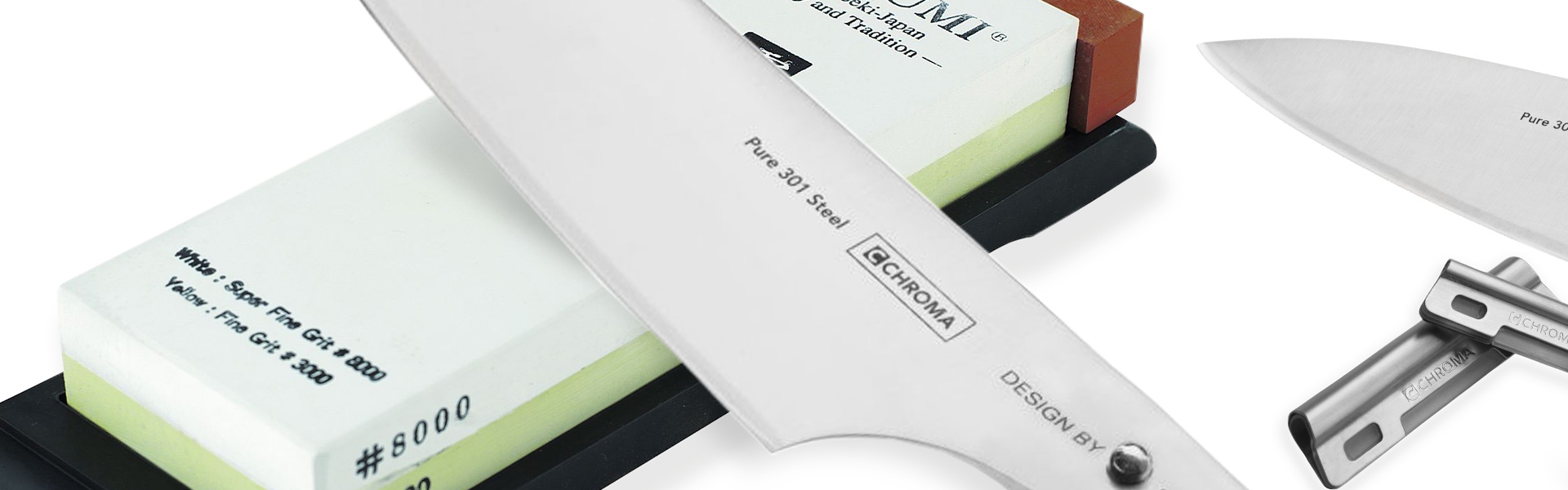

The combined grinding stone CHROMA ST-2/8 has the grain sizes 200 and 800. With the raw size 200 you can repair small blade imperfections. With the smoother size 800 you can carry out the real grinding. 18 x 6,3 x 2,8 cm Grit: 200 / 800 Ideally, the knife should be sharpened daily (for professional cooks) or about every six months (for hobby cooks), and by the same person each time or with the help of a ‘sharping guide‘. Each person has an individual angle at which he or she sharpens the knife. The blade of the knife becomes sharper each time it is sharpened in the same manner, by the same person or with the help of an optional attachable ‘sharping guide‘. This ‘sharping guide‘ helps you hold knife’s edge at 15-20 degree angle when sharpening – the ideal angle. Kitchen Knife Sharpening There are various types of waterstones & ceramic stones available and normally a medium grit stone is sufficient to start with. However, if the blade is blunt or damaged, it may be necessary to start with rough grit. There are several differences between waterstones and ceramic stones. A waterstone must be placed in water and allowed to soak for 10-15 minutes to allow it to absorb sufficient moisture. A ceramic stone also requires water, but only needs to soak in water for 3-5 minutes. A ceramic stone is harder than a waterstone, so it will sharpen your knives more quickly. A ceramic stone will last longer and will not develop valleys or grooves as easily as a waterstone. The stone should be soaked for the required amount of time before use. Hold the knife so that the blade meets the stone at a 10-15 degree angle, then push back and forth across the stone in smooth steady strokes maintaining the same angle. Maintaining the same angle is most important and you will know that you are maintaining the same angle from the sound the knife makes against the stone. If you are making the same sound with each stroke back and forth against the stone, you are maintaining the same angle. Repeat the stage above on both sides of the blade going from one side to the other until your knife is sharp and there are no burrs on either side. During sharpening a certain amount of wet powder will appear, but do not wash or wipe this residue and continue sharpening. Although this powder appears unsightly, it is this residue which sharpens the knives. After sharpening, your knives should be washed in hot water and then towel dried.

Chroma - Ceramic Whetstone ST-1/6 - Grit: 1000 / 6000 - Care and proper use of a high-quality knife is always essential to maintain the best cutting edge and to insure the highest possible degree of safety when using. After all, a dull knife is a dangerous knife. The more pressure required to cut with a knife the greater chance of an accident occurring while it is being used. 18,2 x 6,1 x 2,5 cm grit: 1000 / 6500 with stand incl. Shusei Toishi Ideally, the knife should be sharpened daily (for professional cooks) or about every six months (for hobby cooks), and by the same person each time or with the help of a ‘sharping guide‘. Each person has an individual angle at which he or she sharpens the knife. The blade of the knife becomes sharper each time it is sharpened in the same manner, by the same person or with the help of an optional attachable ‘sharping guide‘. This ‘sharping guide‘ helps you hold knife’s edge at 15-20 degree angle when sharpening – the ideal angle. CHROMA HIGH GRADE WHETSTONES 200 - 240 - Pregrinding of dull knives or smaller repair 800 - 2000 - Standard – For regular sharpening / maintenance of edge. 3000 - 4000 - For perfect sharpness - for use after the 1000's 6000 - 12000 - Polishing – herewith the knife becomes ideal, for use after the 3000' Kitchen Knife Sharpening There are various types of waterstones & ceramic stones available and normally a medium grit stone is sufficient to start with. However, if the blade is blunt or damaged, it may be necessary to start with rough grit. There are several differences between waterstones and ceramic stones. A waterstone must be placed in water and allowed to soak for 10-15 minutes to allow it to absorb sufficient moisture. A ceramic stone also requires water, but only needs to soak in water for 3-5 minutes. A ceramic stone is harder than a waterstone, so it will sharpen your knives more quickly. A ceramic stone will last longer and will not develop valleys or grooves as easily as a waterstone. The stone should be soaked for the required amount of time before use. Hold the knife so that the blade meets the stone at a 10-15 degree angle, then push back and forth across the stone in smooth steady strokes maintaining the same angle. Maintaining the same angle is most important and you will know that you are maintaining the same angle from the sound the knife makes against the stone. If you are making the same sound with each stroke back and forth against the stone, you are maintaining the same angle. Repeat the stage above on both sides of the blade going from one side to the other until your knife is sharp and there are no burrs on either side. During sharpening a certain amount of wet powder will appear, but do not wash or wipe this residue and continue sharpening. Although this powder appears unsightly, it is this residue which sharpens the knives. After sharpening, your knives should be washed in hot water and then towel dried.

CHROMA Whetstone ST-1000 - The standard stone for the regular cut. Our Top-selling! 18,2 x 6,1 x 2,5 cm grit: 1000 with stand CHROMA HIGH GRADE WHETSTONES 200 - 240 - Pregrinding of dull knives or smaller repair 800 - 2000 - Standard – For regular sharpening / maintenance of edge. 3000 - 4000 - For perfect sharpness - for use after the 1000's 6000 - 12000 - Polishing – herewith the knife becomes ideal, for use after the 3000' Kitchen Knife Sharpening There are various types of waterstones & ceramic stones available and normally a medium grit stone is sufficient to start with. However, if the blade is blunt or damaged, it may be necessary to start with rough grit. There are several differences between waterstones and ceramic stones. A waterstone must be placed in water and allowed to soak for 10-15 minutes to allow it to absorb sufficient moisture. A ceramic stone also requires water, but only needs to soak in water for 3-5 minutes. A ceramic stone is harder than a waterstone, so it will sharpen your knives more quickly. A ceramic stone will last longer and will not develop valleys or grooves as easily as a waterstone. The stone should be soaked for the required amount of time before use. Hold the knife so that the blade meets the stone at a 10-15 degree angle, then push back and forth across the stone in smooth steady strokes maintaining the same angle. Maintaining the same angle is most important and you will know that you are maintaining the same angle from the sound the knife makes against the stone. If you are making the same sound with each stroke back and forth against the stone, you are maintaining the same angle. Repeat the stage above on both sides of the blade going from one side to the other until your knife is sharp and there are no burrs on either side. During sharpening a certain amount of wet powder will appear, but do not wash or wipe this residue and continue sharpening. Although this powder appears unsightly, it is this residue which sharpens the knives. After sharpening, your knives should be washed in hot water and then towel dried.

CHROMA Whetstone ST-1800L - Double-sided Whetstone - 240/1000 Grit 240: Pregrinding of dull knives or smaller repair Grit 1000: Standard – For regular sharpening / maintenance of edge. 18 x 6,3 x 2,8 cm grit: 240/1000 with stand CHROMA HIGH GRADE WHETSTONES 200 - 240 - Pregrinding of dull knives or smaller repair 800 - 2000 - Standard – For regular sharpening / maintenance of edge. 3000 - 4000 - For perfect sharpness - for use after the 1000's 6000 - 12000 - Polishing – herewith the knife becomes ideal, for use after the 3000' Kitchen Knife Sharpening There are various types of waterstones & ceramic stones available and normally a medium grit stone is sufficient to start with. However, if the blade is blunt or damaged, it may be necessary to start with rough grit. There are several differences between waterstones and ceramic stones. A waterstone must be placed in water and allowed to soak for 10-15 minutes to allow it to absorb sufficient moisture. A ceramic stone also requires water, but only needs to soak in water for 3-5 minutes. A ceramic stone is harder than a waterstone, so it will sharpen your knives more quickly. A ceramic stone will last longer and will not develop valleys or grooves as easily as a waterstone. The stone should be soaked for the required amount of time before use. Hold the knife so that the blade meets the stone at a 10-15 degree angle, then push back and forth across the stone in smooth steady strokes maintaining the same angle. Maintaining the same angle is most important and you will know that you are maintaining the same angle from the sound the knife makes against the stone. If you are making the same sound with each stroke back and forth against the stone, you are maintaining the same angle. Repeat the stage above on both sides of the blade going from one side to the other until your knife is sharp and there are no burrs on either side. During sharpening a certain amount of wet powder will appear, but do not wash or wipe this residue and continue sharpening. Although this powder appears unsightly, it is this residue which sharpens the knives. After sharpening, your knives should be washed in hot water and then towel dried.

CHROMA Whetstone ST-1800S - Double-sided Whetstone - 240/1000 Grit 240: Pregrinding of dull knives or smaller repair Grit 1000: Standard – For regular sharpening / maintenance of edge. 18,3 x 6,1 x 2,5 cm grit: 240/1000 with stand CHROMA HIGH GRADE WHETSTONES 200 - 240 - Pregrinding of dull knives or smaller repair 800 - 2000 - Standard – For regular sharpening / maintenance of edge. 3000 - 4000 - For perfect sharpness - for use after the 1000's 6000 - 12000 - Polishing – herewith the knife becomes ideal, for use after the 3000' Kitchen Knife Sharpening There are various types of waterstones & ceramic stones available and normally a medium grit stone is sufficient to start with. However, if the blade is blunt or damaged, it may be necessary to start with rough grit. There are several differences between waterstones and ceramic stones. A waterstone must be placed in water and allowed to soak for 10-15 minutes to allow it to absorb sufficient moisture. A ceramic stone also requires water, but only needs to soak in water for 3-5 minutes. A ceramic stone is harder than a waterstone, so it will sharpen your knives more quickly. A ceramic stone will last longer and will not develop valleys or grooves as easily as a waterstone. The stone should be soaked for the required amount of time before use. Hold the knife so that the blade meets the stone at a 10-15 degree angle, then push back and forth across the stone in smooth steady strokes maintaining the same angle. Maintaining the same angle is most important and you will know that you are maintaining the same angle from the sound the knife makes against the stone. If you are making the same sound with each stroke back and forth against the stone, you are maintaining the same angle. Repeat the stage above on both sides of the blade going from one side to the other until your knife is sharp and there are no burrs on either side. During sharpening a certain amount of wet powder will appear, but do not wash or wipe this residue and continue sharpening. Although this powder appears unsightly, it is this residue which sharpens the knives. After sharpening, your knives should be washed in hot water and then towel dried.

CHROMA Whetstone ST-240 - The Whetstone for very dull blades and light repairs. 21 x 7,5 x 2,3 cm grit: 240 with stand CHROMA HIGH GRADE WHETSTONES 200 - 240 - Pregrinding of dull knives or smaller repair 800 - 2000 - Standard – For regular sharpening / maintenance of edge. 3000 - 4000 - For perfect sharpness - for use after the 1000's 6000 - 12000 - Polishing – herewith the knife becomes ideal, for use after the 3000' Kitchen Knife Sharpening There are various types of waterstones & ceramic stones available and normally a medium grit stone is sufficient to start with. However, if the blade is blunt or damaged, it may be necessary to start with rough grit. There are several differences between waterstones and ceramic stones. A waterstone must be placed in water and allowed to soak for 10-15 minutes to allow it to absorb sufficient moisture. A ceramic stone also requires water, but only needs to soak in water for 3-5 minutes. A ceramic stone is harder than a waterstone, so it will sharpen your knives more quickly. A ceramic stone will last longer and will not develop valleys or grooves as easily as a waterstone. The stone should be soaked for the required amount of time before use. Hold the knife so that the blade meets the stone at a 10-15 degree angle, then push back and forth across the stone in smooth steady strokes maintaining the same angle. Maintaining the same angle is most important and you will know that you are maintaining the same angle from the sound the knife makes against the stone. If you are making the same sound with each stroke back and forth against the stone, you are maintaining the same angle. Repeat the stage above on both sides of the blade going from one side to the other until your knife is sharp and there are no burrs on either side. During sharpening a certain amount of wet powder will appear, but do not wash or wipe this residue and continue sharpening. Although this powder appears unsightly, it is this residue which sharpens the knives. After sharpening, your knives should be washed in hot water and then towel dried.

CHROMA Whetstone ST-3/8 - After grinding with the ST-1000 - used this Whetstone with the 3000 grit for the perfect sharpness and then 8000 grit for polishing. 18,3 x 6,1 x 2,5 cm grit: 3000 & 8000 with stand incl. Toishi CHROMA HIGH GRADE WHETSTONES 200 - 240 - Pregrinding of dull knives or smaller repair 800 - 2000 - Standard – For regular sharpening / maintenance of edge. 3000 - 4000 - For perfect sharpness - for use after the 1000's 6000 - 12000 - Polishing – herewith the knife becomes ideal, for use after the 3000' Kitchen Knife Sharpening There are various types of waterstones & ceramic stones available and normally a medium grit stone is sufficient to start with. However, if the blade is blunt or damaged, it may be necessary to start with rough grit. There are several differences between waterstones and ceramic stones. A waterstone must be placed in water and allowed to soak for 10-15 minutes to allow it to absorb sufficient moisture. A ceramic stone also requires water, but only needs to soak in water for 3-5 minutes. A ceramic stone is harder than a waterstone, so it will sharpen your knives more quickly. A ceramic stone will last longer and will not develop valleys or grooves as easily as a waterstone. The stone should be soaked for the required amount of time before use. Hold the knife so that the blade meets the stone at a 10-15 degree angle, then push back and forth across the stone in smooth steady strokes maintaining the same angle. Maintaining the same angle is most important and you will know that you are maintaining the same angle from the sound the knife makes against the stone. If you are making the same sound with each stroke back and forth against the stone, you are maintaining the same angle. Repeat the stage above on both sides of the blade going from one side to the other until your knife is sharp and there are no burrs on either side. During sharpening a certain amount of wet powder will appear, but do not wash or wipe this residue and continue sharpening. Although this powder appears unsightly, it is this residue which sharpens the knives. After sharpening, your knives should be washed in hot water and then towel dried.

KC-90 Rust Cleaner - To eliminate small rust spots on the blade. 6,5 x 4 x 0,9 cm Grit: 180 Kitchen Knife Sharpening There are various types of waterstones & ceramic stones available and normally a medium grit stone is sufficient to start with. However, if the blade is blunt or damaged, it may be necessary to start with rough grit. There are several differences between waterstones and ceramic stones. A waterstone must be placed in water and allowed to soak for 10-15 minutes to allow it to absorb sufficient moisture. A ceramic stone also requires water, but only needs to soak in water for 3-5 minutes. A ceramic stone is harder than a waterstone, so it will sharpen your knives more quickly. A ceramic stone will last longer and will not develop valleys or grooves as easily as a waterstone. The stone should be soaked for the required amount of time before use. Hold the knife so that the blade meets the stone at a 10-15 degree angle, then push back and forth across the stone in smooth steady strokes maintaining the same angle. Maintaining the same angle is most important and you will know that you are maintaining the same angle from the sound the knife makes against the stone. If you are making the same sound with each stroke back and forth against the stone, you are maintaining the same angle. Repeat the stage above on both sides of the blade going from one side to the other until your knife is sharp and there are no burrs on either side. During sharpening a certain amount of wet powder will appear, but do not wash or wipe this residue and continue sharpening. Although this powder appears unsightly, it is this residue which sharpens the knives. After sharpening, your knives should be washed in hot water and then towel dried.

KC-91 Rust Cleaner - To eliminate small rust spots on the blade. 6,5 x 4 x 0,9 cm Grit: 400 Kitchen Knife Sharpening There are various types of waterstones & ceramic stones available and normally a medium grit stone is sufficient to start with. However, if the blade is blunt or damaged, it may be necessary to start with rough grit. There are several differences between waterstones and ceramic stones. A waterstone must be placed in water and allowed to soak for 10-15 minutes to allow it to absorb sufficient moisture. A ceramic stone also requires water, but only needs to soak in water for 3-5 minutes. A ceramic stone is harder than a waterstone, so it will sharpen your knives more quickly. A ceramic stone will last longer and will not develop valleys or grooves as easily as a waterstone. The stone should be soaked for the required amount of time before use. Hold the knife so that the blade meets the stone at a 10-15 degree angle, then push back and forth across the stone in smooth steady strokes maintaining the same angle. Maintaining the same angle is most important and you will know that you are maintaining the same angle from the sound the knife makes against the stone. If you are making the same sound with each stroke back and forth against the stone, you are maintaining the same angle. Repeat the stage above on both sides of the blade going from one side to the other until your knife is sharp and there are no burrs on either side. During sharpening a certain amount of wet powder will appear, but do not wash or wipe this residue and continue sharpening. Although this powder appears unsightly, it is this residue which sharpens the knives. After sharpening, your knives should be washed in hot water and then towel dried.
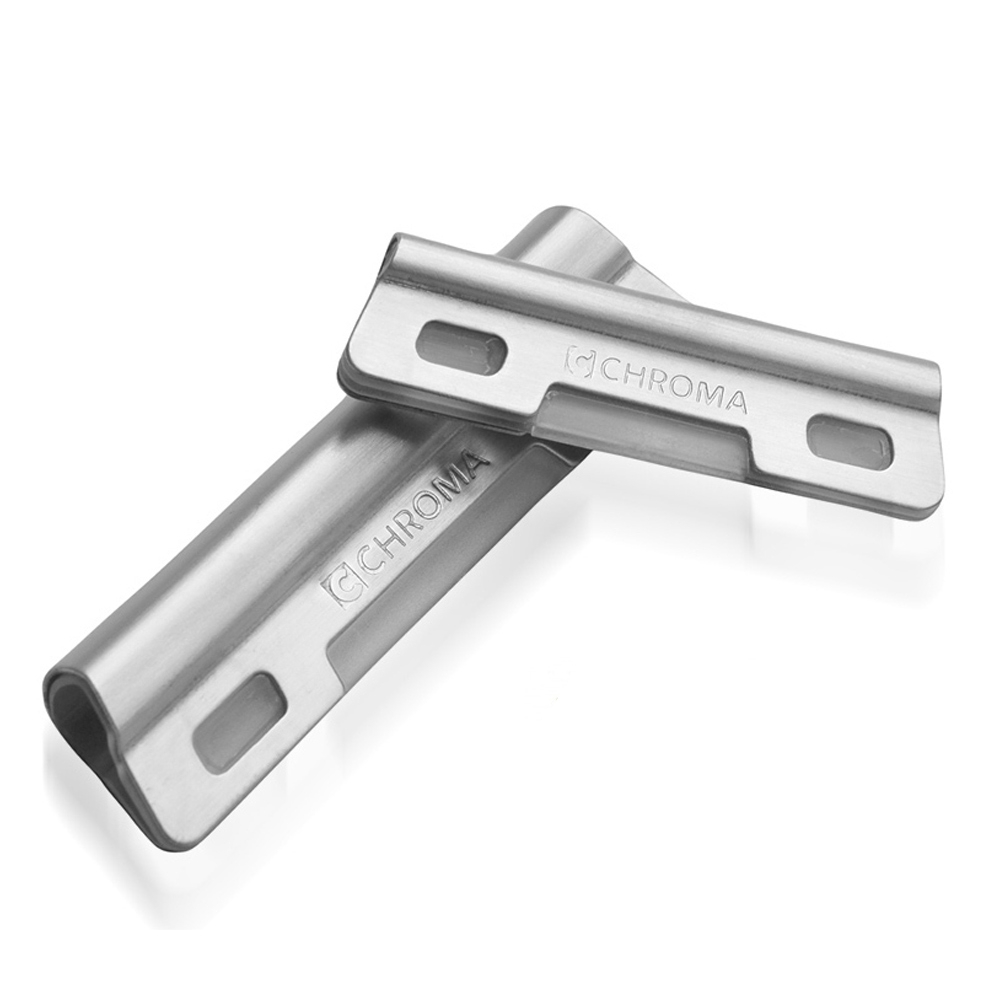
18-8 high-grade steel, stainless, for the right guide angle, with plastic protection. One for knives up to 15 cm blade lenth and over 15 cm. Kitchen Knife Sharpening There are various types of waterstones & ceramic stones available and normally a medium grit stone is sufficient to start with. However, if the blade is blunt or damaged, it may be necessary to start with rough grit. There are several differences between waterstones and ceramic stones. A waterstone must be placed in water and allowed to soak for 10-15 minutes to allow it to absorb sufficient moisture. A ceramic stone also requires water, but only needs to soak in water for 3-5 minutes. A ceramic stone is harder than a waterstone, so it will sharpen your knives more quickly. A ceramic stone will last longer and will not develop valleys or grooves as easily as a waterstone. The stone should be soaked for the required amount of time before use. Hold the knife so that the blade meets the stone at a 10-15 degree angle, then push back and forth across the stone in smooth steady strokes maintaining the same angle. Maintaining the same angle is most important and you will know that you are maintaining the same angle from the sound the knife makes against the stone. If you are making the same sound with each stroke back and forth against the stone, you are maintaining the same angle. Repeat the stage above on both sides of the blade going from one side to the other until your knife is sharp and there are no burrs on either side. During sharpening a certain amount of wet powder will appear, but do not wash or wipe this residue and continue sharpening. Although this powder appears unsightly, it is this residue which sharpens the knives. After sharpening, your knives should be washed in hot water and then towel dried.

The intensive grinding of the chef's knife causes uneven surfaces on the grindstone. With the Toishi stone you can straighten the grindstone again. 6,0 x 2,0 x 1,0 cm Kitchen Knife Sharpening There are various types of waterstones & ceramic stones available and normally a medium grit stone is sufficient to start with. However, if the blade is blunt or damaged, it may be necessary to start with rough grit. There are several differences between waterstones and ceramic stones. A waterstone must be placed in water and allowed to soak for 10-15 minutes to allow it to absorb sufficient moisture. A ceramic stone also requires water, but only needs to soak in water for 3-5 minutes. A ceramic stone is harder than a waterstone, so it will sharpen your knives more quickly. A ceramic stone will last longer and will not develop valleys or grooves as easily as a waterstone. The stone should be soaked for the required amount of time before use. Hold the knife so that the blade meets the stone at a 10-15 degree angle, then push back and forth across the stone in smooth steady strokes maintaining the same angle. Maintaining the same angle is most important and you will know that you are maintaining the same angle from the sound the knife makes against the stone. If you are making the same sound with each stroke back and forth against the stone, you are maintaining the same angle. Repeat the stage above on both sides of the blade going from one side to the other until your knife is sharp and there are no burrs on either side. During sharpening a certain amount of wet powder will appear, but do not wash or wipe this residue and continue sharpening. Although this powder appears unsightly, it is this residue which sharpens the knives. After sharpening, your knives should be washed in hot water and then towel dried.

CHROMA Haiku Original - H-11 Whetstone 800 - Standard - For regular sharpening / maintenance of edge. 18 x 5 x 1,8 cm - 7" x 2" x 0,8" Grit: 800 with stand CHROMA HIGH GRADE WHETSTONES 200 - 240 - Pregrinding of dull knives or smaller repair 800 - 2000 - Standard – For regular sharpening / maintenance of edge. 3000 - 4000 - For perfect sharpness - for use after the 1000's 6000 - 12000 - Polishing – herewith the knife becomes ideal, for use after the 3000' Kitchen Knife Sharpening There are various types of waterstones & ceramic stones available and normally a medium grit stone is sufficient to start with. However, if the blade is blunt or damaged, it may be necessary to start with rough grit. There are several differences between waterstones and ceramic stones. A waterstone must be placed in water and allowed to soak for 10-15 minutes to allow it to absorb sufficient moisture. A ceramic stone also requires water, but only needs to soak in water for 3-5 minutes. A ceramic stone is harder than a waterstone, so it will sharpen your knives more quickly. A ceramic stone will last longer and will not develop valleys or grooves as easily as a waterstone. The stone should be soaked for the required amount of time before use. Hold the knife so that the blade meets the stone at a 10-15 degree angle, then push back and forth across the stone in smooth steady strokes maintaining the same angle. Maintaining the same angle is most important and you will know that you are maintaining the same angle from the sound the knife makes against the stone. If you are making the same sound with each stroke back and forth against the stone, you are maintaining the same angle. Repeat the stage above on both sides of the blade going from one side to the other until your knife is sharp and there are no burrs on either side. During sharpening a certain amount of wet powder will appear, but do not wash or wipe this residue and continue sharpening. Although this powder appears unsightly, it is this residue which sharpens the knives. After sharpening, your knives should be washed in hot water and then towel dried.

size: 18 cm/7" x 5 cm/2" x 2 cm/0,8" grit: 800 Care and proper use of a high-quality knife is always essential to maintain the best cutting edge and to insure the highest possible degree of safety when using. After all, a dull knife is a dangerous knife. The more pressure required to cut with a knife the greater chance of an accident occurring while it is being used. Kitchen Knife Sharpening There are various types of waterstones & ceramic stones available and normally a medium grit stone is sufficient to start with. However, if the blade is blunt or damaged, it may be necessary to start with rough grit. There are several differences between waterstones and ceramic stones. A waterstone must be placed in water and allowed to soak for 10-15 minutes to allow it to absorb sufficient moisture. A ceramic stone also requires water, but only needs to soak in water for 3-5 minutes. A ceramic stone is harder than a waterstone, so it will sharpen your knives more quickly. A ceramic stone will last longer and will not develop valleys or grooves as easily as a waterstone. The stone should be soaked for the required amount of time before use. Hold the knife so that the blade meets the stone at a 10-15 degree angle, then push back and forth across the stone in smooth steady strokes maintaining the same angle. Maintaining the same angle is most important and you will know that you are maintaining the same angle from the sound the knife makes against the stone. If you are making the same sound with each stroke back and forth against the stone, you are maintaining the same angle. Repeat the stage above on both sides of the blade going from one side to the other until your knife is sharp and there are no burrs on either side. During sharpening a certain amount of wet powder will appear, but do not wash or wipe this residue and continue sharpening. Although this powder appears unsightly, it is this residue which sharpens the knives. After sharpening, your knives should be washed in hot water and then towel dried.

KASUMI Masterpiece - K-12 Ceramic Whetstone - Double-sided Whetstone - 3000/8000 incl. Shusei Toishi Grit 3000: For perfect sharpness Grit 8000: Polishing – herewith the knife becomes ideal 18 x 6 x 3 cm grit: 3000/8000 incl. Shusei Toishi with stand HIGH GRADE WHETSTONES 200 - 240 - Pregrinding of dull knives or smaller repair 800 - 2000 - Standard – For regular sharpening / maintenance of edge. 3000 - 4000 - For perfect sharpness - for use after the 1000's 6000 - 12000 - Polishing – herewith the knife becomes ideal, for use after the 3000' Kitchen Knife Sharpening There are various types of waterstones & ceramic stones available and normally a medium grit stone is sufficient to start with. However, if the blade is blunt or damaged, it may be necessary to start with rough grit. There are several differences between waterstones and ceramic stones. A waterstone must be placed in water and allowed to soak for 10-15 minutes to allow it to absorb sufficient moisture. A ceramic stone also requires water, but only needs to soak in water for 3-5 minutes. A ceramic stone is harder than a waterstone, so it will sharpen your knives more quickly. A ceramic stone will last longer and will not develop valleys or grooves as easily as a waterstone. The stone should be soaked for the required amount of time before use. Hold the knife so that the blade meets the stone at a 10-15 degree angle, then push back and forth across the stone in smooth steady strokes maintaining the same angle. Maintaining the same angle is most important and you will know that you are maintaining the same angle from the sound the knife makes against the stone. If you are making the same sound with each stroke back and forth against the stone, you are maintaining the same angle. Repeat the stage above on both sides of the blade going from one side to the other until your knife is sharp and there are no burrs on either side. During sharpening a certain amount of wet powder will appear, but do not wash or wipe this residue and continue sharpening. Although this powder appears unsightly, it is this residue which sharpens the knives. After sharpening, your knives should be washed in hot water and then towel dried. KASUMI MASTERPIECE Kasumi Masterpiece are a special, limited version of the Kasumi knife. They are the result of consistent further development, improvement, and decades of experience in the company Sumikama the blade forging. Kasumi Masterpiece knives are the best that ever. The Japanese character is the character of Kasumi Masterpiece knife. In its actual translation it means something like "masterful handiwork" (Takumi). Kasumi Masterpiece knives get your exceptional properties by the invaluable experience of the best masters and their hand, in connection with the use of modern technology - in the tradition of Japanese sword forging. The middle layer of the Kasumi Masterpiece blade is made of the best Japanese "VG10 Cobalt high carbon steel, which was developed exclusively for production of very high quality kitchen knives. After forging, the blades are again heated to about 800 ° C, then quickly cooled down and so hardened to about 59-60 ° C. Rockwell. The hardness of 59-60 HRC is not only in Japan for optimum hardness as kitchen knives. It allows for a very long service life of the cutting edge (sharpness), but also an equally easy re-sharpening the SUMIKAMA grindstone. The perfect, hot-flashing edge is the product of many grinding operations on rotating special water grinding stones. Only the best from Seki grinder grind each blade of Kasumi Masterpiece at various work steps by hand. Your final sharpness get the knife through the final grinding process with a fine 3000 Kasumi water stone. The Kasumi Masterpiece damask pattern on both sides of the blade, formed by repeated folding and forging of high-grade steel in several layers. The professional handle the Kasumi Masterpiece knives is made of a hard resin thermoset linen. By pressure and heat of this resin is replaced by his special life and so its good shape. The knife is very comfortable and secure in the hand. The beauty of the blade, along with the glossy finish handle - this knife is so unique. Kasumi Masterpiece are beautiful and extremely sharp, they are perfect for any type of preparation of fine cuisine. Kasumi knives are produced by Sumikama Cutlery in Seki, Japan. Sumikama Cutlery specializes in producing knives from very advanced materials with the most advanced manufacturing techniques.

EUR 499.00 per liter for the care of knife blades has a smoothing effect without leaving a greasy film less resistance when cutting cleans protects against corrosion Application: Apply a very thin layer with a cloth and rub in. Term: Prunus armeniaca kernel oil, 10 ml, antibacterial, origin: China, light yellow, mildly scented, pressed from the kernels of sweet apricots The apricot tree probably originally comes from China and came to Italy in Roman times. Today it is cultivated in the Mediterranean region, in Turkey, in Eastern Europe as well as in the USA, Canada, South Africa, Australia and New Zealand. The fruit kernels contain approx. 40-50% light yellow, mildly scented oil, which is not only used cosmetically but is also valued as a fine edible oil when it is pressed from the kernels of the sweet apricot. Apricot kernel oil used cosmetically comes primarily from the bitter kernels of wild apricots. Prunus Armeniaca Kernel Oil is the fixed oil pressed from kernels of apricot, Prunus armeniaca, Rosaceae. It consists mainly of fatty acid glycerides.